

Khalid Kamaraldawla, Regional Sales Director (META), LENSEC
Most enterprise software has stopped caring where it’s installed. What matters now is how easy it is to access, manage, connect to other systems, and scale. Physical security hasn’t quite caught up.
Many organizations have good cameras, solid recording infrastructure, and capable software, but still rely on legacy client architectures. Deployment, maintenance, and expansion require more effort than they should. In distributed environments where security systems connect to other platforms, that overhead adds up quickly.
The next step for physical security isn’t just more cameras or better analytics. It’s the application architecture underneath. Moving from per-workstation installations to centrally managed, browser-based applications makes operations simpler, access more flexible, and systems easier to adapt as requirements change.
Thick Client vs. Web Client
Most enterprise applications historically followed a thick-client model. The software is installed locally on each workstation, runs there, and communicates with a central server.
That model worked for years, but it comes with costs:
- Every workstation needs its own installation and maintenance.
- Updates have to be coordinated across all clients and kept version-compatible with the server.
- Client hardware requirements can be high.
- Adding users or sites usually means more IT work.
A web architecture moves the application to a central host. Users access it through a standard browser, and administration happens in one place. People already work this way every day with other applications: log in, do the task, switch devices, and never deal with installers or compatibility issues. There’s no strong reason security software should be an exception.
Technical Advantages
Location-independent access. Authorized users aren’t bound to a specific machine. For multi-site or multi-country operations, this makes shared visibility and collaboration between security teams much easier.
Centralized deployment and maintenance. Updates, configuration changes, and fixes are applied once, on the server side. That removes most per-workstation patching and reduces version differences between clients.
Scalability. Organizations add sites, adopt new technologies, and change their operating requirements. A web-based client makes it easier to accommodate that growth without rebuilding the client environment.
Platform independence. Modern web applications run across operating systems and compatible browsers, so workstation choice is no longer tied to specific software environments.
Faster delivery of features. With a centralized architecture, releasing improvements is more efficient, allowing vendors to respond faster to customer requirements and emerging technologies.
Integration. Standard APIs and communication protocols make it practical to connect video surveillance, access control, intrusion detection, building management, and AI. These systems increasingly need to interoperate, making integration a baseline requirement.
The VMS Case
VMS products have traditionally relied on dedicated client applications. Proprietary software is installed on each control room workstation, every client is configured separately, and those installations have to be maintained throughout the system’s lifecycle.
At a small scale, that’s manageable. At an enterprise scale, it isn’t.
Consider an organization running 50 facilities, each with its own operators, workstations, IT constraints, and maintenance windows. Managing the application centrally and giving authorized users browser access removes the need to deploy and support a VMS client on every one of those machines. Deployment becomes simpler, and the environment becomes easier to connect to other systems.
Perspective VMS
LENSEC’s view is that physical security is about more than cameras, recording servers, and monitoring stations. The goal is a connected platform that makes security data accessible and actionable.
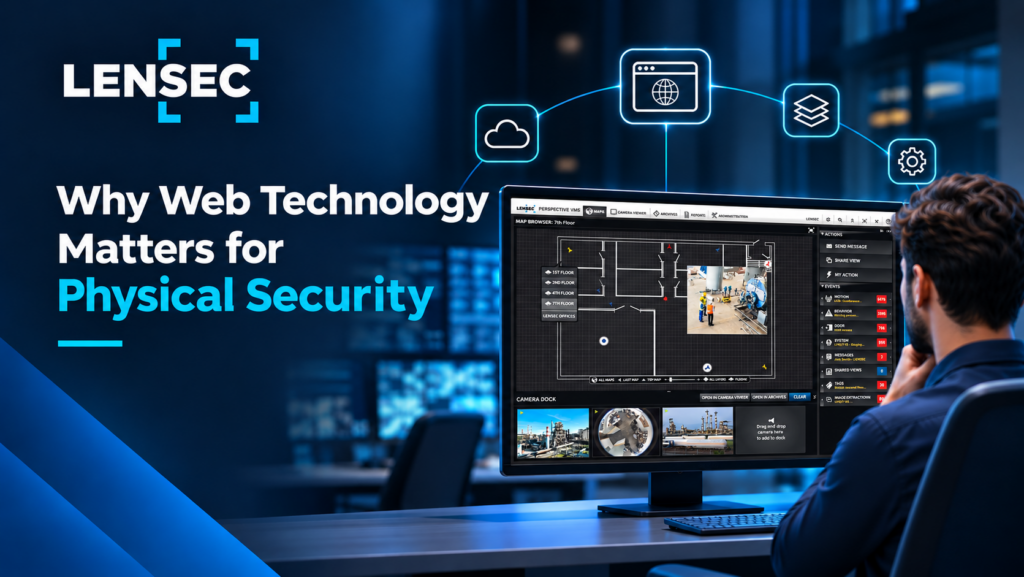
Perspective VMS, our flagship video management solution, is built on web technology. Users access it through modern browsers rather than a dedicated thick client, so no proprietary VMS client is needed on each workstation. That changes how the software is delivered and managed, not just how the interface looks.
The practical benefits differ by role:
- Customers: Simpler user onboarding, workstation setup, and ongoing maintenance.
- IT departments: Fewer software dependencies and less time spent on individual client installations.
- System integrators: Simpler deployment, easier handover, and more efficient long-term support.
Multi-site operation. Large enterprises, government bodies, airports, hospitals, and industrial operators often run security across several facilities, sometimes in different cities or countries. A web-based architecture lets authorized users access the functions they need while administration and control remain centralized.
Integration. Video is one part of the system. Customers expect their security platform to work with access control, analytics, sensors, and other operational technology. LENSEC’s ecosystem covers Perspective VMS, security orchestration, AI capabilities, and access control, with the goal of replacing isolated applications with an integrated environment.
Readiness for new technology. AI, advanced analytics, IoT, and automation are changing what customers expect. A web-based architecture provides a flexible foundation for adding these capabilities and evolving the platform over time. It also leaves the deployment model open: on-premises, cloud, or hybrid.
This doesn’t eliminate infrastructure requirements. Video processing, recording, storage, bandwidth, and cybersecurity remain critical. The difference is that the application architecture provides greater flexibility in how those resources are managed and accessed.
Is the Thick Client Obsolete?
No. Thick clients still make sense in specialized environments that need local processing, dedicated hardware interfaces, or heavily optimized video decoding.
But whether a thick client can deliver the required functionality is no longer the most interesting question. It’s whether it delivers the flexibility, accessibility, and operational simplicity organizations now expect. As web technologies mature, the case for browser-based applications keeps getting stronger. The goal should be to serve customers better, not preserve how software used to be delivered.
Outlook
Physical security platforms will increasingly be judged on how easy they are to access and manage, how well they connect to other systems, and how effectively they turn large volumes of data into usable information. Web technology is one of the foundations for that. For LENSEC, it’s an opportunity to rethink how organizations interact with their security infrastructure.
Customers don’t buy a software architecture. They buy visibility, control, operational efficiency, and confidence that the infrastructure will scale with the business.
Take the Next Step
Ready to take a more connected approach to physical security? Discover how Perspective VMS brings the flexibility of web technology to modern security operations. Connect with LENSEC to explore what a browser-based approach could mean for your organization.