

Vicken Karaoghlanian, VP of Product & Technology, LENSEC
It’s 2:14 A.M. in a security operations center. An incident has been reported on a university campus, and the operator needs to know who came through a restricted door in the past hour and where they went next. Across hundreds of cameras, that once meant hours of scrubbing through footage.
Everything we build at LENSEC exists to turn those hours into minutes. Over the past two years, AI has transformed how quickly and how well we can do that. Here’s what we learned, and why I’ve never been more optimistic about physical security.
An Industry That Can’t Afford to Stand Still
Physical security has always been a careful industry, and for good reason. When your software protects hospitals, campuses, and government agencies, reliability comes first.
But the ground has shifted. Operators once juggled siloed systems from different vendors for video, video analytics, access control, and intrusion detection. Today, organizations are consolidating onto unified platforms with a single view. Meanwhile, cameras, door readers, and IoT sensors keep multiplying, IT and physical security are converging, and cyber threats reach these systems through device firmware and the software supply chain, even in air-gapped deployments. Customers expect their platform to evolve at software speed without any loss of dependability or security.
That pressure is why AI moved from experiment to everyday practice across our product development teams. Within six months of our first pilots, it was part of how we write code, test integrations, and plan releases. Today, nearly every member of our product, engineering, and quality teams uses AI as part of their daily work.
How AI Accelerated Our Development
The gains came across the full product lifecycle, from planning to delivery.
Product requirements. AI helps our product managers turn customer feedback, support tickets, and integrator requests into clear requirements in hours instead of days.
Gap analysis. We compare our capabilities against customer requirements, RFP specifications, and market expectations faster and more thoroughly, sharpening both roadmap priorities and bid responses.
Software engineering. AI helps our engineers build new platform features, improve existing code, and develop integrations for cameras, access control, intercoms, and sensors in a fraction of the time, so they can focus on architecture, reliability, and failover.
Quality assurance. AI helps our quality engineers turn requirements into detailed test plans and scenarios, so we can validate behavior across the wide range of devices and deployment sizes our customers run.
Documentation. Release notes and integration guides now stay current with every release.
Two Sides of AI: How We Build and What We Build
AI changes both how we build and what we build, and product management sits at the center of both. Our product managers turn what we learn from customers and the field into a roadmap focused on where operators struggle most.
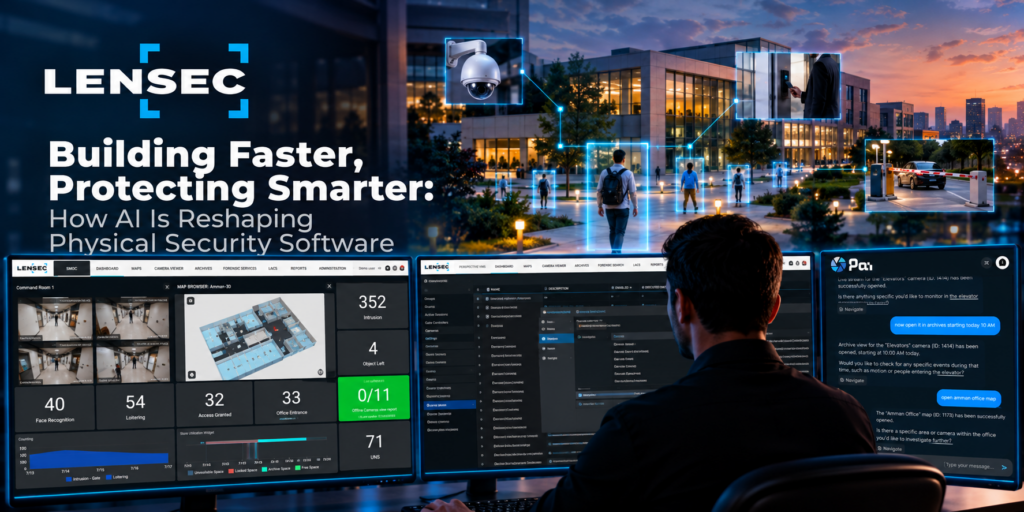
That focus shaped PAI, the AI-powered intelligence at the heart of both our SMOC and Perspective VMS® platforms, with capabilities that include forensic search to help operators find critical footage faster. It guided our work on correlating video, access control, and sensor events into one clear picture. And it shaped LINC, a compact, plug-and-play gateway that securely connects remote, distributed, and mixed-vendor sites to a centralized Perspective VMS.
Product management makes sure we build the right things. Engineering speed brings them to customers sooner.
People Make the Difference
When we introduced AI tools, some people wondered what it meant for their roles. We answered openly: AI doesn’t replace expertise. It amplifies it.
Across every role, our most experienced people became our strongest AI users, because they know what good looks like. Internal playbooks and peer-led workshops helped everyone grow together.
Our industry already lives by this principle: analytics can flag an event, but a trained operator makes the call. Across our team, AI suggests and our people decide.
Security and Trust Come First
A security platform must itself be secure, so we set clear guardrails from day one.
- Every line of AI-assisted code is reviewed and passes the same security scanning and testing as any other code.
- Air-gapped environments stay air-gapped. AI-assisted development never requires connectivity at customer sites, and our web-based platform can be deployed fully on-premises.
- Compliance stays non-negotiable. Our information security management is certified to ISO/IEC 27001:2022, our cloud security controls to ISO/IEC 27017:2015, and our SMOC, Perspective VMS, and LINC products to UL 2900-2-3 Security Level 3 for product cybersecurity.
- Humans stay in the loop for every safety decision.
These guardrails don’t slow us down. They let us move fast with confidence.
The Challenges We Faced
It hasn’t all been smooth.
AI is a fast first draft, not a finished product. Code that looks polished in minutes still has to hold up in a platform that runs 24/7, so validating AI-assisted work is built into our definition of done.
More code means more security review. Automated scanning and clearer checklists help us keep pace.
Customers have questions. Security leaders rightly ask how AI affects cybersecurity and data. Answering transparently and early has strengthened trust.
The Results
The results have exceeded our expectations. Capabilities that once took eight to ten weeks to deliver now often take four to five. We’re releasing more often, supporting more devices and integrations, and catching more issues before they reach the field, without compromising reliability or security. PAI and LINC reached customers faster because of how we now plan, build, and validate.
For security teams, that means the tools they ask for arrive sooner, built to the same standard of reliability.
The Future: How We’ll Build and What We’ll Build
We’re still early, and that’s what excites me most.
In how we build, AI will take on more of the routine work. Product managers will move from insight to requirements faster, software engineers will focus more on architecture, and quality engineers will validate more scenarios in greater depth. Our people will spend more time on design, judgment, and customer conversations.
In what we build, physical security is moving from reactive to proactive. Operators will get early signals that something is developing, with the context to act before it escalates. And when an incident happens, PAI’s forensic search will keep shrinking the time from question to answer.
Some things won’t change. Reliability remains our foundation, cybersecurity and data protection remain non-negotiable, and human judgment stays at the center of every safety decision. Our mission is the same: help people protect people.
Let’s Build What’s Next, Together
The best ideas in our platform come from the people who use it every day. I invite security directors, integrators, and partners to tell us where operators struggle and which integrations would change your day, and to join us on pilots.
AI gives us the ability to move faster than ever. Our customers give us a reason. Together, we can make that 2:14 a.m. moment clearer, calmer, and safer.
Help Shape What Comes Next
Tell us where your operators struggle, which integrations would make a difference, and how you’d like to collaborate on a pilot.