

What a VMS Does Well
A video management system is built for one thing: video. It records footage from IP cameras, organizes it by location and time, and makes it available for live monitoring and playback. For organizations that need to see what is happening across their facilities, a VMS delivers exactly that. It is the right tool for the job it was designed to do.
But what it was designed to do is narrower than what most security operations now require.
The Gap Between Monitoring and Response
Security operations rarely involve a single system. A typical facility runs video alongside access control, intrusion detection, fire alarms, building management systems, and IoT-connected sensors. Each produces events. Each operates through its own interface. When something happens, an operator has to move between all of them to build a picture of what is going on.
An intrusion alert comes in from one system. The camera covering that area is managed in another. The access log showing who badged through that door is in a third. Pulling these together takes time, and that time has a direct effect on how fast and how consistently an organization can respond.
The gap is not a gap in technology. Each system does what it is supposed to do. The gap is in coordination: the work that happens between systems, carried manually by operators, in the moments when response speed matters most.
What a Full Operations Platform Adds
When these systems connect through a single orchestration layer, the coordination work shifts from the operator to the platform.
In practice, this changes how individual events get handled:
- An intrusion sensor activates. The system maps the location, presets the nearest PTZ camera to that position, and surfaces the event in the operator dashboard automatically.
- A fire alarm triggers. Live video from the affected zone opens in the interface. The alarm location highlights on the facility map.
- An access event occurs at a door. The associated camera captures the moment. The footage and the access log entry synchronize for immediate review in one view.
- An IF/THEN workflow fires when a defined condition is met: a specific door forced open after hours activates a camera preset, sends an alert, and logs the incident without any manual steps.
This coordination extends beyond video and traditional security systems. Through APIs, SDKs, and standard protocols such as MQTT, OPC, BACnet, and Modbus, a full operations platform can incorporate events and data from compatible third-party systems, sensors, and IoT devices. This allows organizations to build workflows around a broader range of operational conditions, rather than limiting automated responses to a predefined set of security events.
None of this requires operators to switch interfaces or manually connect the dots. The response is already organized before they act on it.
SMOC As the Orchestration Layer
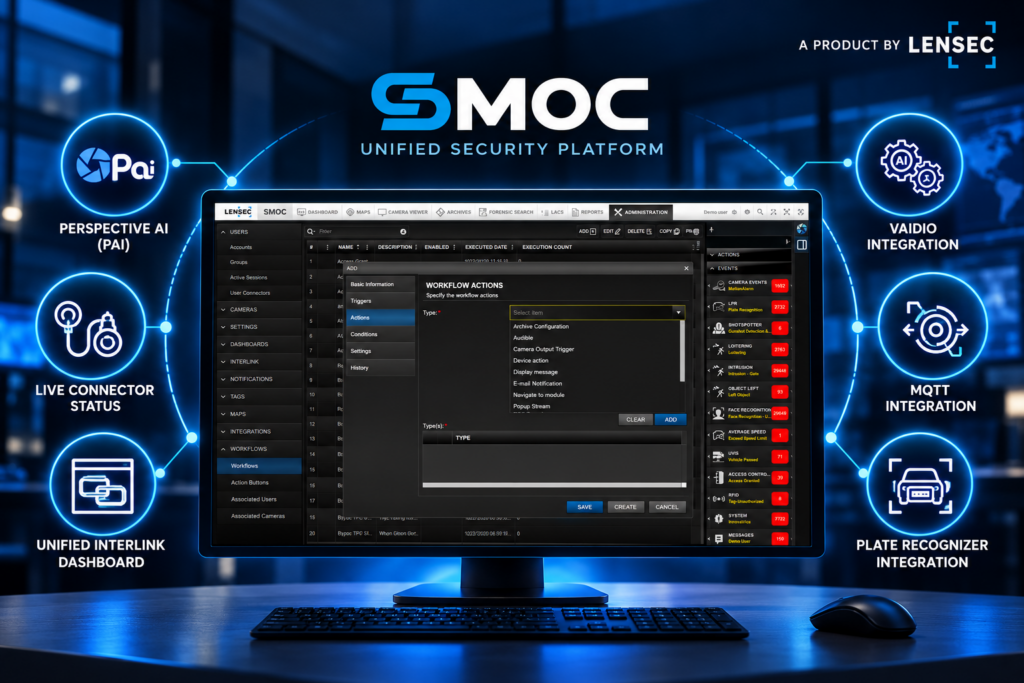
SMOC is LENSEC’s Unified Security Platform. It centralizes disparate security systems under one interface and adds a workflow automation engine on top of that unified view.
The platform integrates across three categories of systems. In the main category: IP security video, access control, and video analytics. At the perimeter: intrusion detection, proactive prevention, explosion detection, and driveway barriers. Through third-party connections: fire alarm systems, building management systems, and IoT devices.
Beyond native integrations, SMOC supports connectivity with third-party systems through APIs and SDKs, extending integration possibilities across the physical security environment. It also supports standard communication protocols, including MQTT, OPC, BACnet, and Modbus, enabling integration with compatible sensors, IoT devices, and building or industrial systems.
Beyond integration, SMOC provides incident management tools, forensic search with filtering by time, motion, metadata, and tags, and multi-camera synchronized playback for event review. Its IF/THEN workflow engine lets security teams define automated response logic for the conditions that matter most to their operations, connecting events across integrated systems to predefined actions.
SMOC runs entirely in a browser. There is no dedicated console to install, no client software to maintain, and no workstation update cycle to manage. Access is controlled at the account level, allowing authorized operators to access the platform from any location through a browser.
SMOC connects natively to Perspective VMS, Perspective AI, LACS (LENSEC Access Control System), and LINC (LENSEC Integrated Node Connector). Together, these solutions bring the LENSEC platform under one interface.
From Reactive to Proactive Security.
Who This Platform Is Built For
The gap between a VMS and a full operations platform is sharpest in environments where multiple systems need to work together and response time carries real consequences.
Multi-site organizations managing security across distributed locations benefit from a single command center that provides visibility and response capability across all of them. High-security environments with perimeter systems, barriers, and under-vehicle inspection need those inputs feeding into one operational view. Critical infrastructure with regulatory requirements around audit trails and incident documentation needs a system that captures and records event correlation automatically. Complex facility environments in healthcare, education, and government run fire, access, video, and environmental systems simultaneously and need them to communicate.
In each of these contexts, what the organization is managing is not video. It is an operation. A VMS is one component of that operation. A unified security platform is what holds the rest of it together.
The Bigger Picture
A VMS is the right foundation. It is not the complete picture. As physical security operations expand to include more systems, more data sources, and higher expectations for response speed, the question shifts. It is no longer just whether to use video management. It is what the rest of the operation runs on.
The answer requires a platform that can take in events from across a facility, connect them to the right video and data, and act on them through automated workflows rather than manual coordination. That is what SMOC is built to do.
To learn more about SMOC and the LENSEC platform, visit www.lensec.com.