

 Dua’a Taha, Quality Manager, LENSEC
When you evaluate a security platform, you ask the obvious questions: uptime, integrations, support response times. You rarely ask the one question that quietly determines all of those answers before a single camera feed or access event ever reaches you: how was this actually tested?
I manage the team at LENSEC that has to answer that question honestly, release after release. Over the past year we changed the answer, by rebuilding how we test around a discipline most security vendors talk about and few practice at this depth: an AI-driven quality organization built to keep pace with software that touches physical security.
The Coverage Problem Doesn’t Scale the Old Way
A modern security platform is not one thing to test. It’s a web application, a set of APIs, a database that has to stay correct under concurrent writes, third-party systems we don’t control, identity providers, notification gateways, camera and hardware protocols and a performance profile that has to hold under real load, not demo load.
Every one of those surfaces needs its own kind of scrutiny, on every release. The traditional answer, add more testers and hope coverage keeps up with scope, doesn’t hold, and coverage that quietly shrinks as a platform grows is exactly the failure mode a security customer can least afford.
What We Built Instead
We didn’t hire a bigger Quality team in the old shape. We built one in a new one: a set of AI quality agents, each with a single, well-defined job, organized the way a mature testing practice is actually organized by phase of the testing lifecycle, and by discipline. One agent turns a product requirement into something genuinely testable, and flags what’s ambiguous before anyone writes a test against a guess. Another owns the test plan and decides, deliberately, what needs deep coverage this cycle and what doesn’t. From there, specialist teams work in parallel: functional UI behavior, manual usability and accessibility review, API and database integrity, performance under load, security and access-control testing, and the two kinds of integration testing this industry depends on most: whether our own modules still agree with each other, and whether the platform behaves correctly when a system it depends on does not.
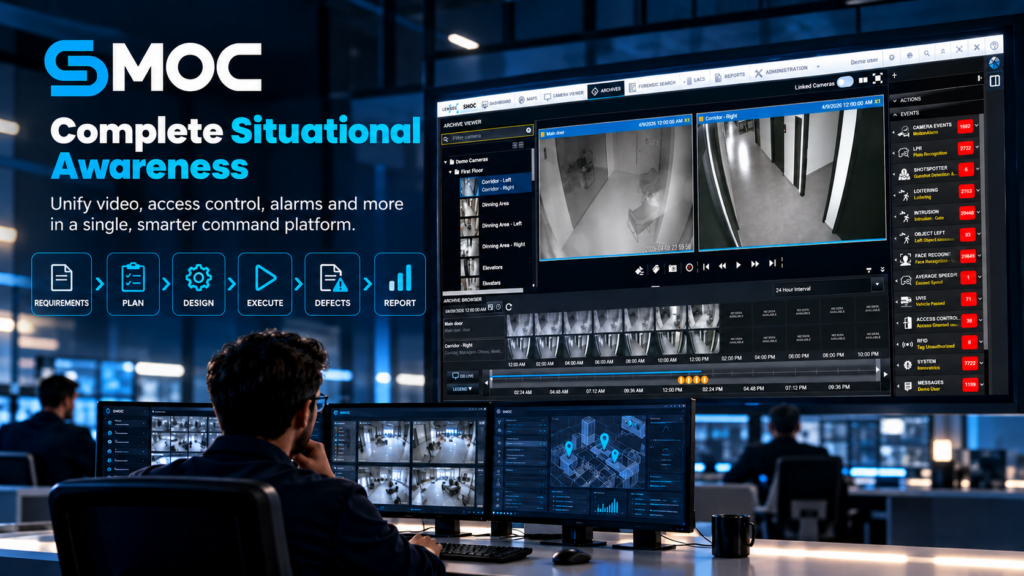
REQUIREMENTS → PLAN → DESIGN → EXECUTE → DEFECTS → REPORT
Traceability Is the Discipline, Not the Paperwork
One rule holds the whole system together, and it’s simple to state and hard to enforce:
Every test traces back to a requirement. Every defect traces back to a test.
Nothing gets flagged because it “looked off.” It gets flagged because a documented requirement said this must behave a certain way, and the evidence says it didn’t. That discipline is what turns a pile of test results into something a decision-maker can actually trust: not “we tested a lot,” but a straight line from what we checked, to why, to what we found.
Watching for What a Single Test Would Miss
The agents also watch what a person testing one feature by hand would likely overlook. While a test runs, the same system is reading browser console errors, network failures, application logs and server resource usage in the background, because the defect that matters most is rarely the one written into the test script. It’s the one quietly filling an event log three steps after the feature under test appeared to pass.
The Judgment Stays Human
None of this replaces judgment, and it was never meant to. Every requirements analysis, every test plan, and every set of test cases is reviewed and approved by a human quality engineer before execution begins: the agents propose, we decide. Volume and vigilance are a machine’s job. Deciding what “correct” means for the people who rely on us is still, deliberately, ours.
Why This Belongs in a Conversation About AI Adoption
This is what AI adoption looks like from where I sit, not a feature announcement, but a discipline that got measurably better at its actual job: finding the problem before the people who depend on us do. It’s a small, unglamorous example of a larger commitment across LENSEC, using AI where it changes an outcome, not just where it makes a good headline. If you’re trusting a security platform with your sites, that’s the question worth asking every vendor, including us, not whether they use AI, but where, and why it makes what you rely on more dependable, rather than just faster to ship.
If you want to see what that looks like for a release headed your way, ask me. I am glad to walk any customer through what a build actually goes through before it reaches them. Contact us for more details.